
Need help with your leases?
At Bénoline, we assist landlords with clear leases, managing annexes, and implementing rules that protect your income. Contact us to get support for your rental property management.

July 2025
In our first article on Quebec leases, "The Quebec Lease Agreement: An Essential Guide for Landlords", we explained the importance of the lease as the legal foundation of a rental relationship and highlighted key points landlords need to know.
This step-by-step guide complements that overview by breaking down each section of the official lease form (from A to I), offering practical advice, tips, and red flags to safeguard your rental income and avoid disputes.
| Official Title | Content | Key Points for the Landlord | |
|---|---|---|---|
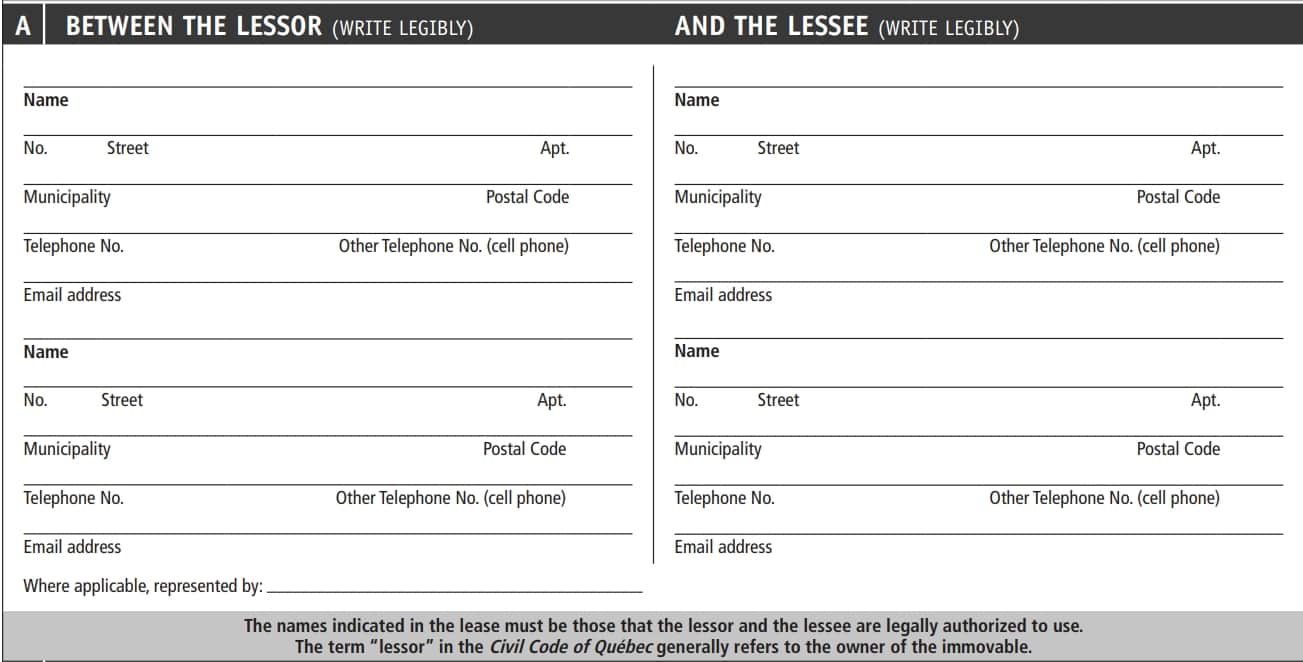
| A | Identification of the Parties | Full name, address, and contact information for the landlord and tenant | It's important to have all adult occupants sign for joint liability. |
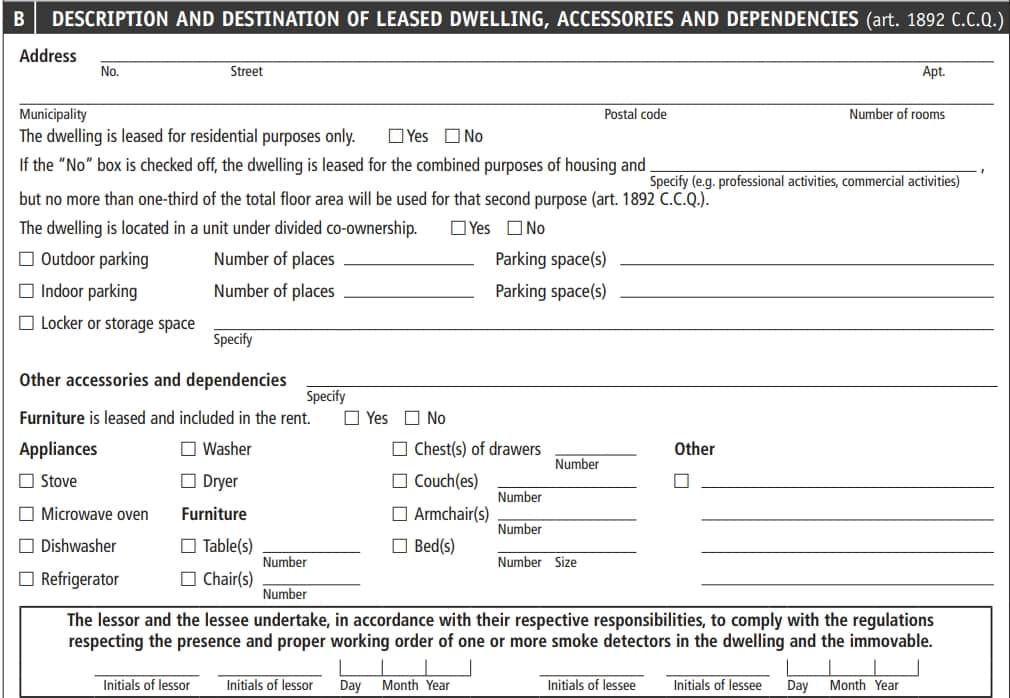
| B | Identification of the Leased Dwelling | Complete address, type of dwelling, parking, storage, and other dependencies | Clearly describe what is included to avoid any ambiguity. |
| C | Lease Term | Start and end dates, renewal process | A 1-year lease is recommended; be cautious with seasonal or pro-rata cases. |
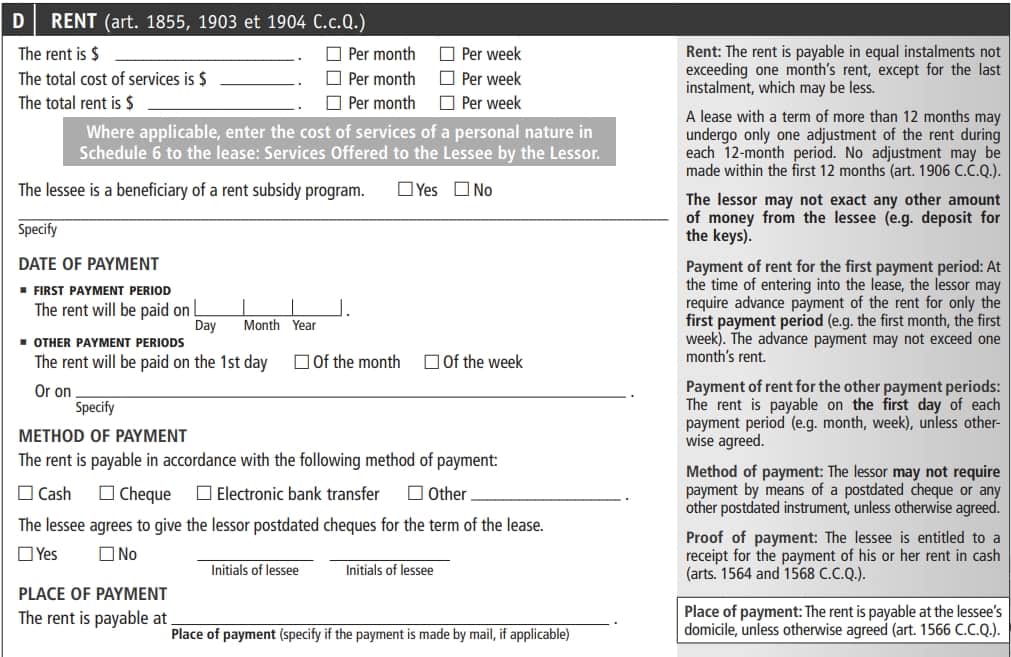
| D | Rent | Amount, payment date and method, previous rent paid | Verify the market price and fulfill the legal obligation to state the previous rent. |
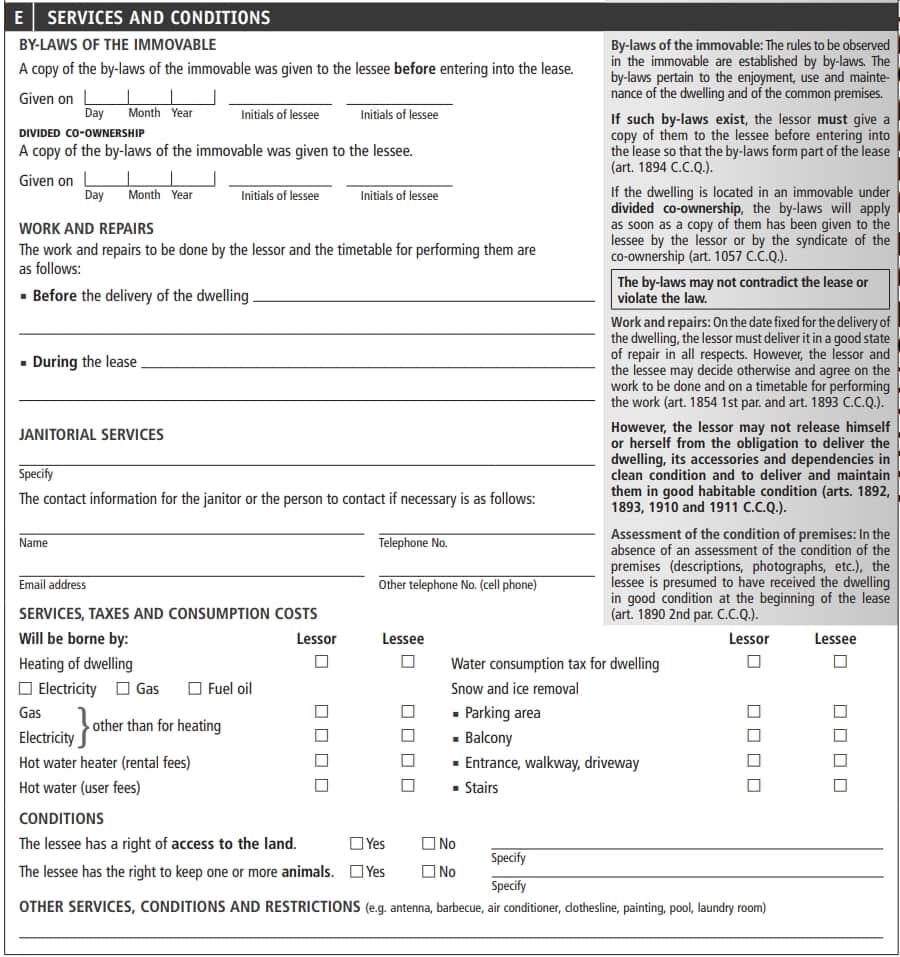
| E | Services and Conditions | Heating, electricity, hot water, parking, and other services | It's possible to include a cap on services (e.g., electricity or heating in kWh/year). |
| F | Rent Setting Restrictions | Special cases (new housing, subsidized, renovated) | Be aware of special rules; don't check boxes randomly. |
| G | Notice to New Tenant or Sub-tenant | Previous rent and conditions | A legal obligation that is important to avoid future disputes. |
| H | Signatures | Signature of the parties | Each signature is a legal commitment; be mindful of non-signing occupants. |
| I | Notice of Family Residence | Declaration on the use of the dwelling as a family residence | Has legal implications in case of a separation. |
👉 What the Lease Requires
Full name, address, and contact information for the landlord and tenant.
💡 Tip
Have all adult occupants sign. Each signatory becomes jointly responsible for rent payment, minimizing the risk of unpaid rent.
⚠️ Red Flag
If only one tenant signs, that person is legally responsible; other occupants have no obligations.
📌Annex to Include
None.
👉 What the Lease Requires
Address, unit number, parking, storage, and all included items.
💡 Tip
Be explicit: “1 outdoor parking space” is clearer than “parking included.” List furniture and appliances provided.
⚠️ Red Flag
Anything not mentioned in the lease is assumed not included.
📌Annex to Include
Detailed inventory of appliances, furniture, and equipment.

👉 What the Lease Requires
Start and end dates, or an indefinite term.
💡 Tips
- A 1-year lease is recommended for greater security, as it reduces uncertainties for both parties.
- An indefinite lease can suit long-term or flexible rentals.
- For mid-month start/end, include a prorated rent (e.g., starting June 15 = half month).
⚠️ Red Flag
Seasonal or prorated leases require precise calculations to avoid disputes.
📌Annex to Include
None, except for seasonal leases or detailed prorated rent calculations.
👉 What the Lease Requires
Rent amount, payment date & location, previous rent if applicable.
💡 Tips
- Check market rates using Quebec Rent Registry, Zumper Montreal, Louer.ca, Kijiji, Facebook Marketplace, Centris,
- For rent increases, use the official TAL form: TAL Rent Increase Calculator.
⚠️ Red Flag
Do not request a security deposit; only the first month or advance payment is allowed.
📌Annex to Include
None.
👉 What the Lease Requires
Section E is crucial, as it defines the included services, how costs and services are shared, and establishes the connection with the building’s by-laws.
Building By-Laws
A copy of the building by-laws must be provided to the tenant no later than at the signing of the lease and must be countersigned. The by-laws set out the rules governing the enjoyment, use, and maintenance of both common areas and private spaces. A by-law cannot contradict the lease or violate the law.
📌Internal link: See our drafting guide: How to Create Your Building By-Laws? to ensure you have clear and enforceable rules.
Repairs and Maintenance (Before/During the Lease)
This is where you specify any particular repairs and timelines the landlord agrees to complete, or any unusual agreements related to major work.
Reminder: The landlord must deliver and maintain the dwelling in a habitable condition.
Services, Taxes, and Utility Costs
This section specifies how costs are shared for services such as snow removal, landscaping, electricity, and gas.
⚠️ Red Flag: Any service not specified is assumed excluded, but if marked “included,” tenants may request it without limit.
Conditions
This subsection is essential for defining the tenant’s right to access the property grounds and specifying whether they are allowed to keep pets. Access to the grounds refers to permission to use outdoor spaces (such as a garden, yard, or balcony) for personal activities (e.g., having a barbecue, setting up a patio table).
⚠️ Note: If the grounds are for common use, this access must be governed by the building bylaw. If pets are permitted, you can add further details in the next section or in the building bylaw (e.g., maximum weight, number of animals).
Other Services, Conditions, and Restrictions
This catch-all section allows you to add specific conditions (as long as they do not violate the law) governing lifestyle and maintenance.
💡 Tips
- Include services with a yearly cap instead of a monthly amount: e.g., electricity = 12,000 kWh/year.
- Be precise: “Unlimited high-speed Internet” is not the same as “Internet included.”
📌Annex to Include
Document specifying annual cap and service conditions.
(to include under “Other services, conditions, and restrictions”)
To clarify the tenant’s routine maintenance responsibilities—without repeating what the Civil Code already states—you can focus on tasks that need clarification.Here’s an example to adapt to your situation:
“The tenant is responsible for routine maintenance and minor repairs, including but not limited to: replacing light bulbs, cleaning and replacing air-conditioning filters (if applicable), unclogging drains and toilets due to negligence, maintaining provided appliances (if applicable), and upkeep of the private outdoor areas of the dwelling (entrance, balcony, flowers, lawn).”
⚠️ Warning: Never include a clause that contradicts the landlord’s fundamental obligations, such as transferring responsibility for major repairs (e.g., roof, structure). Such a clause would be considered void by the Tribunal administratif du logement (TAL).
👉 What the Lease Requires
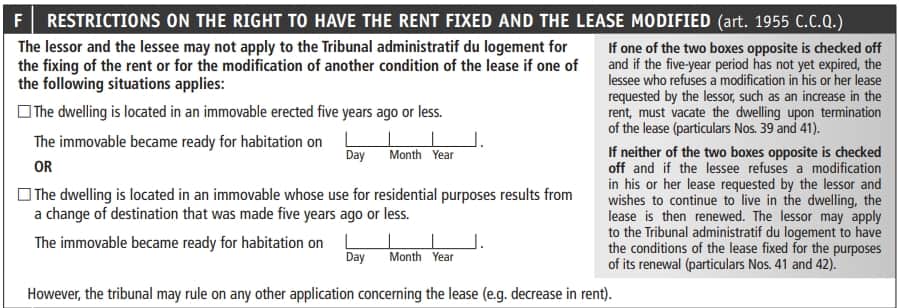
Indicate if the dwelling was built or converted into a dwelling less than 5 years ago.
💡 Tip
If your building is new (less than 5 years since its construction or change of use), keep the proof (invoices, permits, certificate of occupancy).
⚠️ Red Flag
Errors may invalidate your rent increase rights.
📌Annex to Include
Copies of supporting documents.
👉 What the Lease Requires
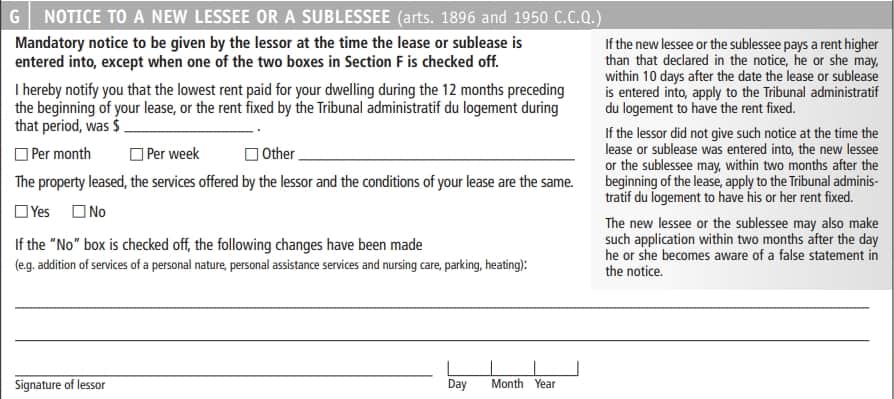
Indicate the rent paid by the previous tenant and the prior conditions.
💡 Tip
Fill out this section accurately. Avoid providing more information than required: the legal obligation is only to state what the lease specifies.
⚠️ Red Flag
Leaving this section blank or filling it out incorrectly may open the door to challenges before the TAL.
📌Annex to Include
You may include a copy of the previous lease or the TAL form. This is an option to show transparency, but it is not mandatory.
👉 What the Lease Requires
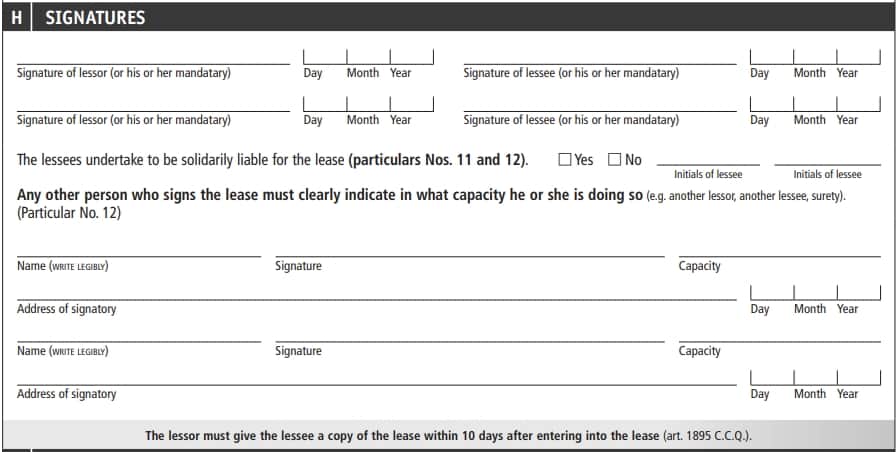
Signatures of landlord and tenant.
💡 Tip
Have all adult occupants sign to secure rent payments.
⚠️ Red Flag
Without the landlord’s signature, the lease is not legally valid unless it is signed by a licensed residential real estate broker (OACIQ). However, we do not recommend this option, since the landlord remains legally responsible for the lease. The landlord’s signature makes it easier to exercise recourse and manage disputes before the TAL.
📌Annex to Include
None.
👉 What the Lease Requires
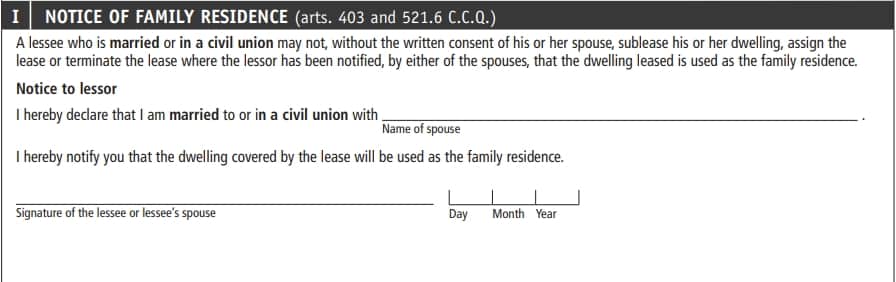
A declaration by the tenant indicating whether the dwelling will be used as a family residence.
💡 Tip
Ask the tenant if they will be living with their partner and invite the partner to sign this section. This prevents an undeclared partner from later invoking rights, which could complicate a lease termination or repossession.
⚠️ Red Flags
Even without this mention, a partner may still retain legal rights over the dwelling, leading to:
- Risk of disputes if only one partner signs and the other later claims conjugal status.
- Delays and complexity in the event of an assignment, termination, or repossession of the unit.
📌Annex to Include
None.
Filling out a Quebec residential lease requires precision and care. This step-by-step guide complements our first article on leases and helps landlords protect their rental income.
👉 Update - August 2025: For further reading, explore our guides on Building Bylaw:
1. Can I ask for a security deposit?
Normally no. The law only allows you to collect the first month’s rent in advance.
Exception: if the tenant offers a deposit themselves because their financial record is less solid. In that case, the landlord must also provide other equivalent options, such as requesting a guarantor or accepting a roommate.
2. Should all adult occupants sign?
Not legally required, but strongly recommended.
3. Can I set a service cap?
Yes, especially for electricity, ideally in annual kWh.
4. What if I make a mistake on previous rent?
Tenants can contest or appeal the increase to TAL.
5. Are included furniture/appliances guaranteed?
No, you can indicate they are provided without guarantee in an annex.
